


Textile
Introduction to Pia Myrvold's Universe in Textile Art
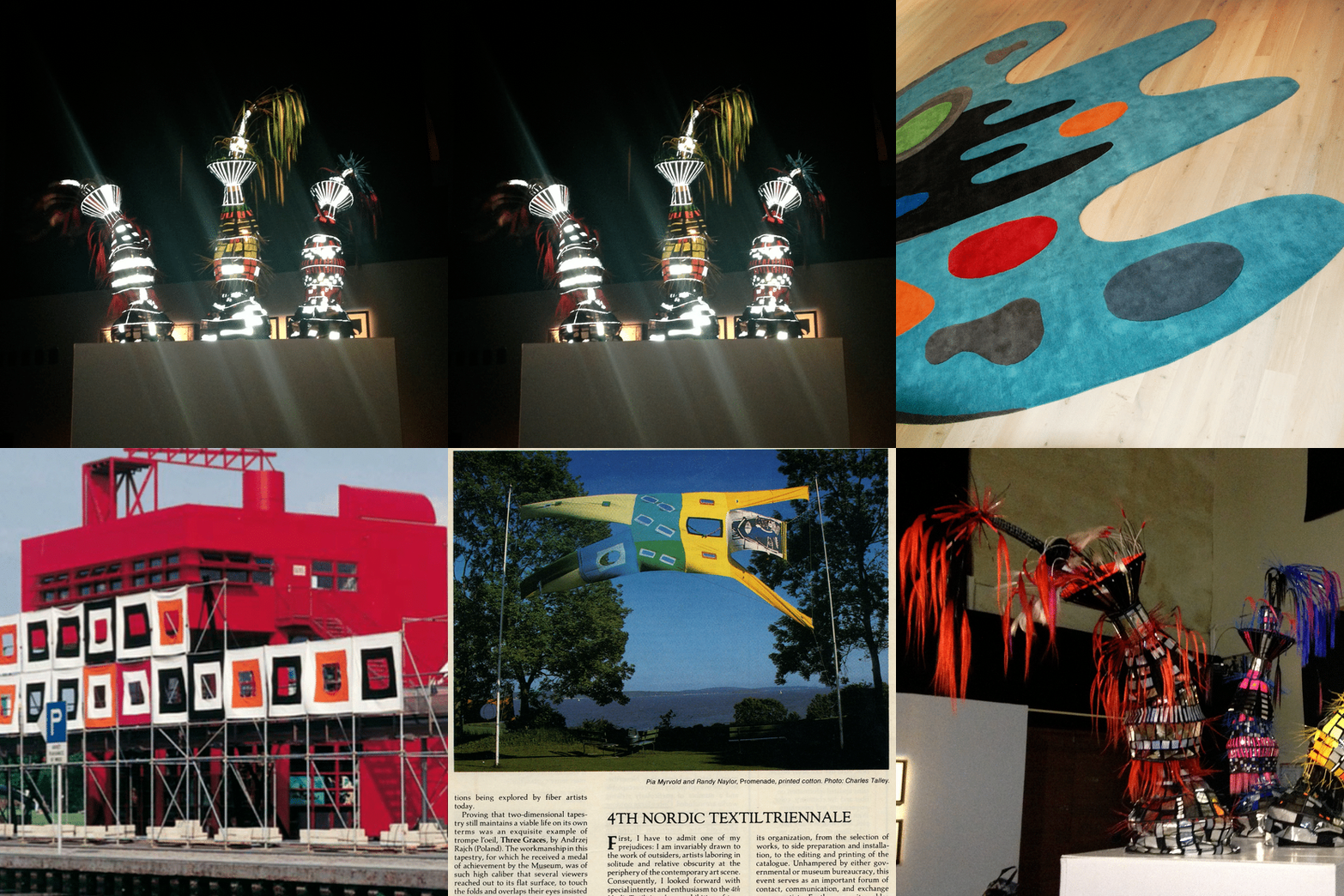
Pia Myrvold has been passionate about crafts and textiles from a young age. She began sewing at only nine years old when she purchased her own sewing machine. During her childhood, she spent countless hours in the Salvation Army depots in her hometown, immersing herself in the study of garments, formal wear, delicate silks, embroidery, weavings, and curtains. Myrvold meticulously examined the constructions, materials, buttons, zippers, and design cuts used in these pieces. With a limited budget, it's clear that she acquired much of her extensive textile knowledge during her early years. In addition to studying these items, she also purchased pieces to redesign or incorporate into various craft projects, developing her distinctive style and crafting her own clothing throughout her teenage years. Early Artistic Passion Myrvold's first deep commitment to art was through painting, particularly during her AFS grant in Santa Cruz, California, where she fell in love with oil and canvas. Since then, she has defined painting as her primary medium. Textile Techniques and Theatre Her textile skills initially came into play while creating costumes for the 1980s theatre group Chameleon Circus. This evolved into a revenue model where she created wearable art pieces to sell in the market and at her own studio, which she opened to the public once a week. She conducted extensive research in textile printing, experimenting with batik, dyes, block printing, and eventually establishing a chemical studio for working with reactive prints. Blurred Lines Between Textile and Fashion Myrvold's work in textiles defies simple classification, as it has intermingled with fashion and textile design through her experimentation with fibres, treatments, dyes, prints, and applications, as well as the incorporation of smart technology.fibres Notable Exhibitions and Installations In her 1983 solo exhibition at the Haugesund Art Museum, Myrvold showcased a large anthropomorphic form, which served as the basis for an outdoor textile competition for the Scandinavian Textile Triennale in 1985. There, colourful figurative forms were draped between buildings, trees, and flagpoles. In 1992, this series culminated in an ephemeral architecture commission in Parc de La Villette, where she designed scaffolding structures and extension pavilions within Bernard Tschumi's permanent grid design for the futuristic park. This project, commissioned by President Mitterrand as part of the Grand utilisedProjects and supported by the Ministry of Culture, utilised 5,000 meters of textiles to create the 500-meter Promenade de Voiles along the canal as part of the Paris Summer exhibition program. Iconic Collections and Innovative Techniques In 1994, Myrvold entered the Syndicat des Créateurs de Modes official calendar in Paris. By then, she had created all the textiles in the CocoonCocoon Collection by tearing up cotton toile, sewing it together, and washing the assembled pieces to achieve a mille-feuille texture. For her project Paris Identity, her studio collected plastic bags from Parisian flagship stores and institutions, cutting the logos into 1 cm strips and reassembling them onto transparent tulle or canvas. Digital Innovations and Research In her venture into cybercouture and innovation with a digital design platform, Myrvold aimed to disseminate contemporary ideas in art, architecture, and philosophy through a mainstream platform and distribution model. Additionally, she sought to create a circular production and distribution model to avoid slave labor, overproduction, and a market flooded with low-quality products. From 1996 to 2002, Myrvold engaged in extensive research with transfer printing, transitioning from sublimation to digital printing, as showcased in the 2002 collection Cybercouture Hypermix, which debuted during New York Fashion Week and featured prints from designer Karim Rashid. Smart Textiles and Unique Techniques Myrvold has also explored smart textiles, researching various breakthroughs in textile innovations and including her work in several publications by Bradley Quinn and fashion libraries worldwide. In Female Interfaces, presented in Centre Pompidou, 2004, she built a textile interface that responder to movements and controls in the garment. Beyond her innovative treatments and textile experimentation, Myrvold developed a unique approach to cutting and shaping garments. Often cutting on the bias and being among the first designers in Paris to implement tech fabrics, she aimed to eliminate excessive seams, thus creating fluid, comfortable, and elegant designs. Her ability to cut and shape fabrics became a pivotal factor in her success in the elite design world and avant-garde boutiques around the globe. Recent Developments By 2015, Myrvold had dedicated significant time to merging her disciplines into new media art installations. In her work Hybrid Love, she dressed three robotic arms in a soft shell, blurring the lines between textile kinetic art and haute couture for robots. Textile interiors, MONUMENTALS From 2005 to 2016, Myrvold designed art Carpets in hand tufted wool, first for Hødnebø AS in Norway, and for Triwest AS, a Swedish Company. Snøhetta Architects commissioned her to design monumental hand crafted art carpets for the public reception areas in the Clarion Energy Hotel, Stavanger Norway, in 2016. A few of these designs were exhibited in San Francisco BAD Space Gallery the same year, and in the Marbella Design Fair, Spain in 2018. In the performance based art project The Sumerians on Holiday, 2019 - ongoing, Myrvold use her skillset to create the visual identity and costumes for the characters. The prints derive from digital 3D images found in her videos and art works, again bringing her hybrid multi-surface universe into play. Recent Developments and Monumentals From 2005 Myrvold has designed art carpets in hand-tufted wool, first for Hødnebø in Norway and then for TriWest AS, a Swedish company, that also appear in the gestalt strategies in design exhibitions, private and public art commissions. In 2016, the architecture firm Snøhetta commissioned her to create monumental handcrafted art carpets for all public reception areas in the Clarion Energy Hotel in Stavanger, Norway. Some of these designs were exhibited at BAD Space Gallery in San Francisco that same year. In the performance-based art project The Sumerians on Holiday (2019 - ongoing), Myrvold utilised her skills to develop the visual identity and costumes for the characters. The prints derive from digital 3D images found in her videos and artworks, further exemplifying her hybrid methodology and multi surface philosophy. Her work is included in several public collections, including The National Museum in Oslo, Kode - West Norway Museum of Decorative Art in Bergen, and Nordenfjeldske Art and Design Museum in Trondheim. Pia Myrvold is a member of both the Norwegian Textile Artists (NTK) and Norwegian Textile Artists (NTK).


